Wednesday, 18 September 2013

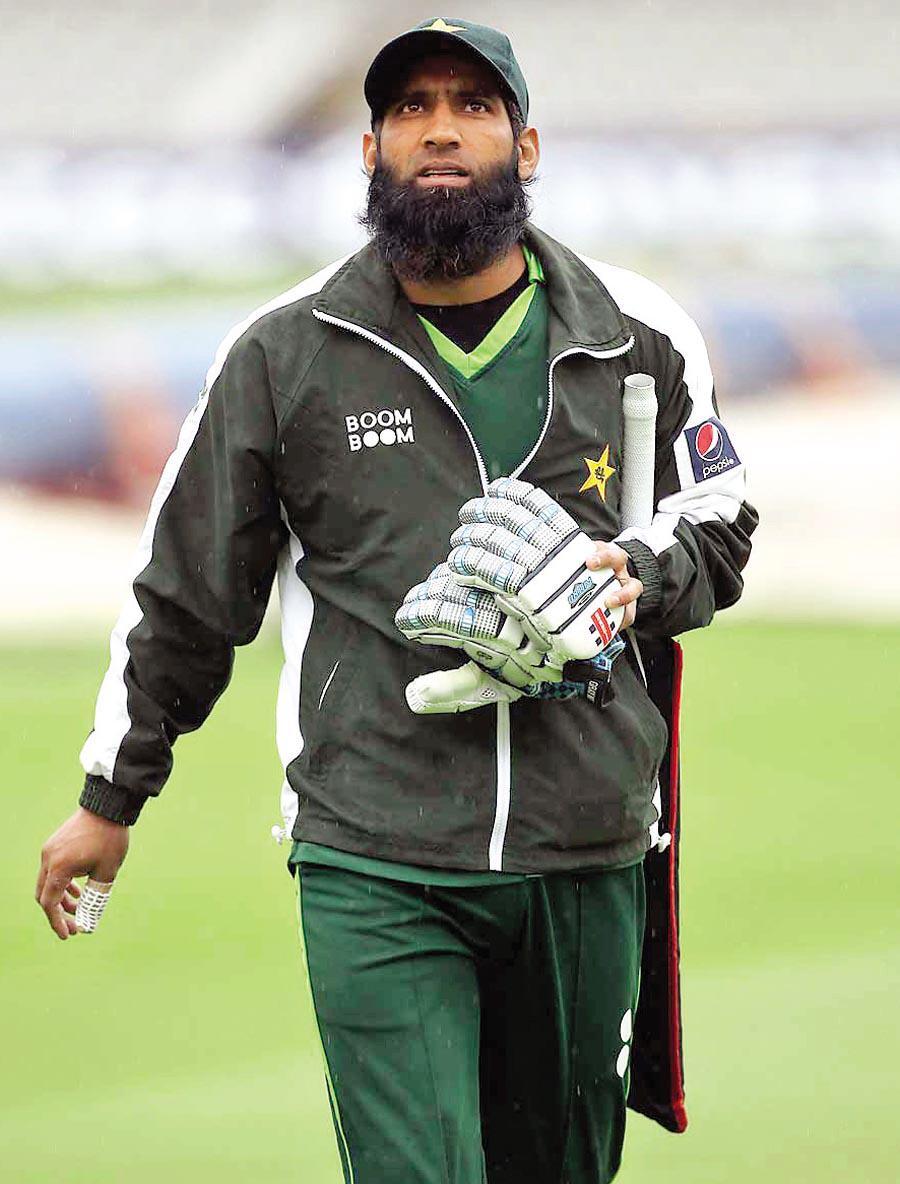
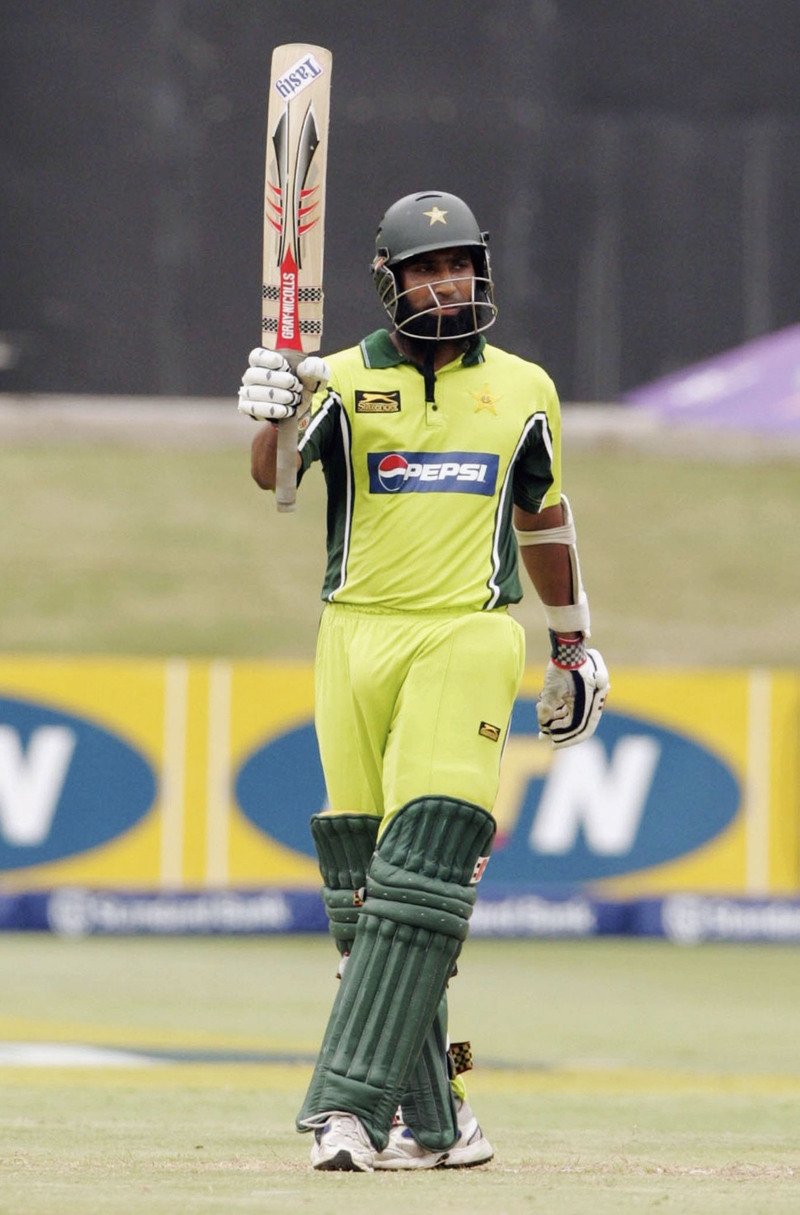
Muhammad Yousuf

Muhammad Yousuf  Biography

Source link (google.com)

Yousuf was born in Lahore, Punjab, Pakistan to a low caste Hindu Balmiki family who later converted to Christianity.[4] His father Youhana Maseeh worked at the railway station, the family lived in the nearby Railway Colony. As a boy, he couldn't afford a bat and so swatted his brother's taped tennis ball offerings with wooden planks of various dimensions on surfaces masquerading as roads. As a 12-year-old, he was spotted by the Golden Gymkhana, though even then only circumstances dictated his ambitions and never thought of playing cricket, to make a living. He joined Lahore's Forman Christian College and continued playing until suddenly giving up in early 1994.[5] For a time he tried his luck driving rickshaws in Bahawalpur.[6]
Yousuf, hailing from poor background, was plucked from the obscurity of a tailor's shop in the slums of the eastern city of Lahore to play a local match in the 1990s. His well-crafted shots attracted attention and he rose through the ranks to become one of Pakistan's best batsman. He was set to work at a tailor's when he was pulled back by a local club was short of players. They called him to make up numbers and made a hundred which led to a season in the Bradford Cricket League, with Bowling Old Lane, and a path back into the game
Until his conversion to Islam in 2005, Yousuf was the fourth Christian (and fifth non-Muslim overall) to play for the Pakistan cricket team, following in the footsteps of Wallis Mathias, Antao D'Souza and the Anglo-Pakistani Duncan Sharpe.[7] He also has the distinction of being the first and so far only non-Muslim to captain the country, leading the team in the 2004–05 tour of Australia where he scored a century in the Boxing Day Test at the Melbourne Cricket Ground. He converted to Islam after attending regular preaching sessions of the Tablighi Jamaat, Pakistan's largest non-political religious grouping, whose preachers include Yousuf's former team-mate Saeed Anwar and his brother. His wife Tania converted along with him and adopted the Islamic name Fatima.
He made his Test debut against South Africa at Durban and One Day International debut against Zimbabwe at Harare. He has scored over 9,000 One Day International runs at an average above 40 (2nd highest batting average among Pakistani batsmen after Zaheer Abbas) and over 7,000 Test runs at an average above 50 (highest batting average amongst all Pakistani batsmen) with 24 Test centuries. He has the record of scoring the most runs without being dismissed in the One Day International match, with a total of 405 runs against Zimbabwe in Zimbabwe in 2002–2003. He has also scored a 23-ball fifty and a 68-ball hundred in One Day International. In Test match, he has scored a 27-ball fifty, which is 3rd fastest by any player. He was the top scorer during the successive years of 2002 and 2003 in the world in One Day International match. In 2004, he scored 111 runs against the Australians in the Boxing Day Test. In December 2005, he scored 223 runs against England at Lahore, also earning him the man of the match award. Seven months later in July 2006, when Pakistan toured England, he scored 202 runs and 48 in the first Test, again earning himself the man of the match award. He followed up with 192 in the third Test at Headingley and 128 in the final Test at The Oval.

Muhammad Yousuf 

Muhammad Yousuf 


Muhammad Yousuf

Muhammad Yousuf 


Muhammad Yousuf
 

Muhammad Yousuf 

Muhammad Yousuf
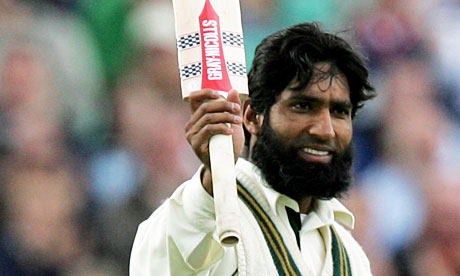
 

Muhammad Yousuf


Muhammad Yousuf


Muhammad Yousuf


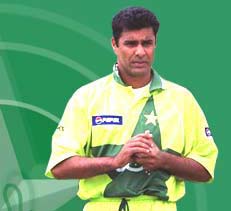
Waqar Yunis

Waqar Yunis Biography

source link (google.com)

Younis was born in Vehari, Punjab in Pakistan in a Jatt family. He was educated in Sadiq Public School in Bahawalpur in Pakistan, the Pakistani College (Pakistan Islamia Higher Secondary School) in Sharjah and the Government College University in Vehari. He was raised in Sharjah in the United Arab Emirates, where his father was a contract worker. He returned to Pakistan during his adolescent years and there, he started playing cricket.

He is married to Dr. Faryal Waqar Younis with a son Azaan Waqar and a daughter Maira Waqar and now lives in Castle Hill in Australia. Younis has also worked as a television sports commentator for the Nine Network in Australia and for Ten Sports in the United Arab Emirates.

Cricket and coaching career
Younis began his cricket career in Pakistan, playing for several First-class cricket clubs. However he suffered an injury when he had cut and removed his little finger on his left hand, after he had jumped into a canal. He recovered from this accident and went on to continue his sporting career. He was eventually discovered by former Pakistan captain, Imran Khan and was selected to be part of the national side. The turning point of his career happened in England, during the late 1980s and early 1990s, when he played for Surrey County Cricket Club. There he displayed excellent cricketing performances and attracted attention from the sporting public.

He made his International cricket debut for Pakistan against India on 15 November 1989, in the same match that Indian batsman Sachin Tendulkar also made his debut. Younis took 4 wickets in the drawn match including the wickets of Tendulkar and Kapil Dev. He made an immediate impression with his speed and became known in the cricket media as "Wiki" or the "Burewala Express". Younis along with Wasim Akram opened the bowling attack regularly for Pakistan, becoming a feared and potent attack. His most recognized delivery was an inswinging yorker. At his peak, he developed into a very quick fast bowler and also became famous for achieving a hat-trick in a One Day International match against New Zealand in 1994. He won the English County Championship with Glamorgan in 1997. During the early periods of 2000, he stayed out of the Pakistan team for a brief period allegedly due to suspension and conflicts with bowling partner and captain Wasim Akram. His return to cricket came with him being appointed the captain of Pakistan, a position he held until his team failed to make an impact in the 2003 Cricket World Cup. He retired from cricket in 2003 after the Pakistan Cricket Board persistently ignored him for national selection.

In March 2006, he was appointed as the bowling coach for Pakistan. He resigned from this position on 6 January 2007 in protest against the Pakistan Cricket Board decision to retain him only for the Test series against South Africa and not for the subsequent series of five One Day International matches. He was re-appointed as Pakistan's bowling and fielding coach for their tour of Australia in December 2009. In February 2010, Younis was appointed the head coach of Pakistan after Intikhab Alam was sacked as coach, due to the low-level of performances of the national side during the tour of Australia earlier that year.

Waqar's first job as coach was to lead an inexperienced Pakistan side missing Younis Khan, Mohammad Yousuf and Shoaib Malik to the 2010 ICC World Twenty20 as a consolation though Waqar had two top-notch bowlers in Mohammad Amir and Mohammad Asif at his disposal. He guided the defending champions to the semi-final of the tournament before the were knocked out by Australia courtesy of a superb 60* by Mike Hussey who whacked three sixes in the final over to seal the victory.

Award and records
See also: List of international cricket five-wicket hauls by Waqar Younis
Younis was awarded Wisden Cricketers of the Year in 1992 for his sporting achievements. He is also the only bowler to have taken a 5 wickets in an innings in 3 consecutive One Day International matches. He has taken a 5 wicket hauls on 13 occasions in One Day International matches. In terms of deliveries bowled, he has taken the fastest 50, 300, 350 and 400 wickets in One Day International matches and the fastest 150, 200, 250, 300 and 350 wickets in Test matches.

Although primarily a fast bowler, Younis scored 1010 Test match runs during his career. As of September 2005, he was the only non-batsman to achieve a thousand runs without scoring a fifty.

Younis holds the record for the best strike rate for any bowler with over 200 Test wickets.

Waqar Yunis

Waqar Yunis


Waqar Yunis


Waqar Yunis


Waqar Yunis


Waqar Yunis


Waqar Yunis


Waqar Yunis


Waqar Yunis


Waqar Yunis


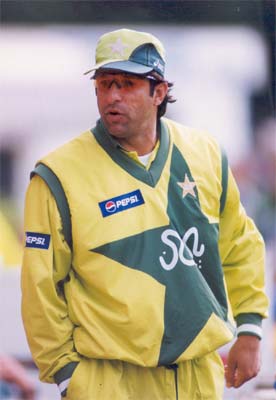
Wasim Akram

Wasim Akram Biography
Source link 9google.com)

Wasim Akram (Urdu: وسیم اکرم)(born June 3, 1966 in Lahore, Punjab) is a former Pakistani cricketer. He was a left-arm fast bowler and left-handed batsman, who represented the Pakistani cricket team in Tests and One-Day Internationals. He is widely regarded as one of the finest fast bowlers ever and holds world records for the most wickets taken in both ODIs (502) and List A cricket (881). Domestic career
Wasim signed for Lancashire in 1988 and went on to become one of their most successful overseas players. From 1988 to 1998, he spearheaded their attack in their NatWest Trophy, Benson & Hedges Cup and Sunday League winning sides. He was a favourite of the local fans who used to sing a song called "Wasim for England" at Lancashire's matches.

International career
Wasim made his Test debut for Pakistani cricket team against New Zealand in early 1985 and in only his second Test he made his presence felt with a ten-wicket haul. Like a few other Pakistani cricketers of his time, he was identified at club level and bypassed first-class domestic competition, entering international cricket directly. A few weeks prior to his selection into the Pakistani team, he was an unknown club cricketer who had failed to even make it to his college team. He was spotted by Javed Miandad, and as a result of his insisting was it that Wasim was given an oppurtunity to play for Pakistan. Later that season he paired with Imran, who became his mentor, at the World Championship of Cricket in Australia.

Wasim's rise in international cricket was rapid during the initial years. When Pakistan toured the West Indies in 1988, he looked to be the quickest bowler between the two sides. However, a serious groin injury impeded his career in the late 1980s. Following two surgeries, he re-emerged in 1990 as a bowler who focused more on swing and control than speed.

One-Day success
Wasim was instrumental in Pakistan's famous World Cup victory in 1992 in Australia. In the final against England his late flurry of an innings, 33 off 19 balls, pushed Pakistan to a respectable 249 for 6. Wasim then took the all-important wicket of Ian Botham early on, and when brought back into the attack later on, with the ball reverse swinging, he produced a devastating spell which led to Allan Lamb and Chris Lewis being clean-bowled in successive deliveries. His excellent performances earned him the Man of the Match award for the final.
Retirement
Wasim retired in 2003, after a brief spell with Hampshire in England. Since then, Wasim has taken up commentary and can currently be seen as a sportscaster for the ESPN Star network, and is also running shows on ARY Digital.

He is married to Huma Mufti, daughter of Mr. Humayaun Mufti. Huma and Wasim have two sons from their marriage of thirteen years.

Wasim Akram


Wasim Akram

Wasim Akram

Wasim Akram

Wasim Akram

Wasim Akram

Wasim Akram

Wasim Akram

Wasim Akram

Wasim Akram


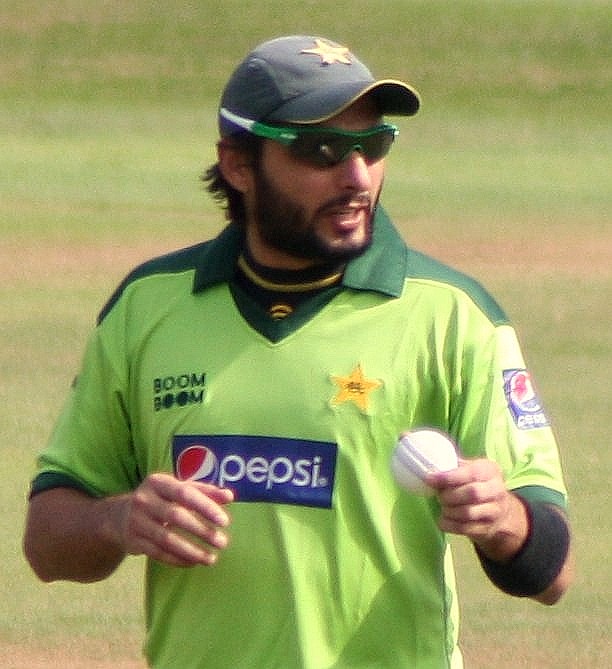
Shahid Afridi

Shahid Afridi Biography

Source link (google.com)


 Shahid Afridi is a professional cricket player, who was born on March 1, 1980 in Khyber Agency, Pakistan. His parents are of the Afridi tribe in Kohat; he is married to Nadia and has two daughters, Aqsa and Ansha.

Nicknamed ‘Boom Boom Afridi’ for his aggressive batting style, Shahid Afridi is a brilliant all-rounder, as he is also a right-arm leg-spin or medium-paced bowler. In October 1998, he made his Test debut for the Pakistan team against Australia and became a reliable member of his side. Shahid Afridi scored five Test centuries in his career, as of the year 2008; three times against India (1999 and twice in 2006) and twice against the West Indies (2002 and 2005).

His first appearance in an One Day International (ODI) came on October 2, 1996 at Nairobi in a match played against the Kenya cricket team. He rose to become an indispensable member of the Pakistani ODI squad with his remarkable performances since 1996. By making the fastest hundred runs (included six boundaries and eleven 6’s) of 37 balls in an ODI match against Sri Lanka, Shahid Afridi beat the record of Sanath Jayasuriya, a famous Sri Lankan cricketer, on October 4, 1996. He was just 16 years, when he performed this feat and was the youngest player to have achieved such an accomplishment. With Brian Lara, he shares a joint record for scoring the third fastest ODI century out of 45 balls against India in April 2005. By making four of the top eight fastest ODI half centuries, Shahid Afridi has made a mark for himself in the history of ODI cricket. In 2007, he scored 32 runs (including four consecutive sixes) off six balls against Sri Lanka at Abu Dhabi. The over was bowled by Malinga Bandara which is considered to the second most expensive over in the ODI history.

In March 2005, his Test performance with the bat and the ball played a key role in Pakistan’s encounter against India. Shahid Afridi made 50 runs out of 26 balls and walked away with three wickets in the second innings of a Test match claiming the victory for his team and brought the series to a draw. In January 2006, he smashed four consecutive sixes against Harbhajan Singh’s bowling in a Test match against India. On achieving a combination of 5000 runs and 200 wickets, Shahid Afridi is the third player (after Sanath Jayasuriya and Jacques Kallis, a South African cricketer) to accomplish such a feat in the ODI history.

Shahid Afridi 

Shahid Afridi

Shahid Afridi 

Shahid Afridi 

Shahid Afridi 

Shahid Afridi

Shahid Afridi

Shahid Afridi 

Shahid Afridi 

Shahid Afridi


Monday, 16 September 2013

Kamran Akmal

Kamran Akmal  Biography

Source(google.com.pk)
Full name Kamran Akmal

Born January 13, 1982, Lahore, Punjab

Major teams Pakistan, Asia XI, Lahore, Lahore Blues, Lahore City, Lahore Eagles, Lahore Lions, National Bank of Pakistan, Punjab Stallions, Rajasthan Royals

Playing role Wicketkeeper batsman

Batting style Right-hand bat

Fielding position Wicketkeeper

Relation Brother - Adnan Akmal, Brother - Umar Akmal

Kamran Akmal


Kamran Akmal may well be the most emphatic proof of cricket's changed priorities post Adam Gilchrist. Sides now search for an explosive batsman who can change a day, an innings, a phase with the bat and so long as you can identify right wicketkeeping glove from left, the place is yours.There has been little doubt about Akmal's batting. The purity of his drives and the strength of his cutting and pulling, particularly on slower subcontinent surfaces, has always held a strong allure. And when it comes together as it did one January morning in Karachi against India - one of the Test innings of that decade - he makes it in the side as a batsman alone.


But his glovework, which began so promisingly when he effectively ended the dogfight between Rashid Latif and Moin Khan in late 2004, has deteriorated alarmingly and few Pakistan matches are complete without a clumsy Akmal error. It wasn't always thus, for he was good when he began, good enough to impress Ian Healy. But non-stop cricket in all three formats have let technical errors creep in and critics and experts have long pushed for the need for him to take a break.To quality spin, he is often as lost as the batsmen and Danish Kaneria, over the years, has suffered in particular. In a string of error-ridden performances, the one nobody will forget will be the four dropped catches (and a missed run-out) in the Sydney Test of 2009-10, which allowed Australia to escape with a remarkable, traumatic win. Against this the memory of his Karachi hundred will always battle, with no clear winner ever likely to emerge. The tryst with controversy does his cause no good, with his refusal to accept his demotion from the side in the aftermath of a disastrous Sydney Test in 2009, eliciting a harsh fine and a disciplinary probation from the PCB.

Kamran Akmal 

Kamran Akmal 

Kamran Akmal 

Kamran Akmal 

Kamran Akmal 

Kamran Akmal 

Kamran Akmal 

Kamran Akmal 

Kamran Akmal 

Kamran Akmal 

Kamran Akmal